The ancient city of Babylon stands as a monumental testament to human ambition, religious devotion, and political ingenuity, its name echoing through millennia as both a symbol of grandeur and a cautionary tale. Emerging as a dominant force in Mesopotamia, Babylon’s legacy transcends its physical ruins, embedding itself in mythology, law, and language while shaping the cultural narratives of civilizations from antiquity to the modern era. From the towering ziggurats that pierced the heavens to the codified justice of Hammurabi’s laws, Babylon’s influence permeates history, art, and even contemporary discourse, where its name evokes themes of power, corruption, and the enduring quest for meaning.
This exploration delves into the multifaceted dimensions of Babylon, dissecting its historical foundations, symbolic resonance, linguistic evolution, and archaeological remnants. By examining its rise and fall through the lens of governance, religion, and cultural exchange, we uncover how Babylon’s innovations—such as its legal systems, astronomical observations, and architectural marvels—laid the groundwork for later societies. Simultaneously, the city’s mythological portrayals, from the Tower of Babel to apocalyptic prophecies, reveal deeper anxieties about human hubris and divine retribution. Through comparative analyses with contemporaneous empires and modern reinterpretations, this discussion illuminates Babylon’s duality: a cradle of civilization and a mirror reflecting humanity’s contradictions.
Historical and Cultural Foundations of Babylon
Babylon emerged as one of the most influential city-states in ancient Mesopotamia, serving as the political, economic, and cultural heart of the region for over a millennium. Founded on the Euphrates River in southern Mesopotamia (modern-day Iraq), Babylon’s legacy is defined by its legal innovations, monumental architecture, and religious syncretism. Its rise coincided with the decline of earlier Sumerian city-states, while its fall marked the transition to Persian and later Hellenistic dominance. The city’s significance extended beyond Mesopotamia, shaping legal traditions, astronomical knowledge, and artistic conventions across the Near East.
Babylon’s historical trajectory reflects a dynamic interplay of conquest, cultural assimilation, and administrative reform. From its origins as a minor settlement under the First Babylonian Dynasty (c. 1894–1595 BCE) to its apogee under Nebuchadnezzar II (605–562 BCE), the city evolved from a regional power to an imperial capital. Its decline, punctuated by Persian conquest (539 BCE) and later Hellenistic rule, underscored its enduring influence on subsequent civilizations, including the Jews (via the Babylonian Captivity) and Greeks (through Alexander the Great’s conquest).
Founding Myths and Early Origins
Babylon’s mythological origins are intertwined with the god Marduk, who, according to the Enuma Elish (Babylonian Creation Epic), overthrew the primordial chaos deity Tiamat and established order. This myth justified Babylon’s theological supremacy over rival cities like Larsa and Assyria, where other deities (e.g., Enlil or Ashur) held prominence. Archaeological evidence suggests Babylon’s earliest habitation dates to the Uruk period (c. 4000–3100 BCE), but its formal establishment as a city-state occurred under Sumu-abum (c. 1894 BCE), founder of the First Babylonian Dynasty.
The city’s strategic location—situated between the Euphrates River and the Sippar canal system—facilitated trade and agriculture, making it a natural candidate for political consolidation. Early Babylonian rulers, such as Sumu-la-El and Sabium, expanded the city’s territory through diplomacy and military campaigns, though its true ascendancy began under Hammurabi (r. 1792–1750 BCE), whose reign marked the empire’s golden age.
Key Rulers and Their Contributions
Babylon’s political history is defined by three pivotal rulers whose reforms and conquests reshaped Mesopotamia:
Hammurabi (r. 1792–1750 BCE)
Hammurabi’s reign is best known for the Code of Hammurabi, a monumental legal compilation of 282 laws inscribed on a diorite stele. The code standardized justice, commerce, and social hierarchy, with penalties tailored to class (e.g., a noble’s injury to a commoner was punished more severely than vice versa). His military campaigns unified southern Mesopotamia, incorporating cities like Larsa and Eshnunna into a centralized state. The stele’s prologue claims divine mandate:
"Marduk, the great lord, has appointed me to promote the welfare of the people, to cause justice to prevail in the land, to destroy the wicked and the evil, that the strong might not oppress the weak."
Hammurabi’s infrastructure projects, including canals and temples, further cemented Babylon’s economic dominance.
Nebuchadnezzar I (r. 1125–1104 BCE)
Though less celebrated than his later namesake, Nebuchadnezzar I (of the Kassite Dynasty) expanded Babylon’s borders into northern Mesopotamia, clashing with Assyria. His reign saw the construction of the Etemenanki ziggurat, a precursor to the biblical "Tower of Babel," and the establishment of Babylon as a religious center for Marduk.
Nebuchadnezzar II (r. 605–562 BCE)
The most iconic Babylonian ruler, Nebuchadnezzar II transformed the city into a Hanging Gardens-adorned metropolis and a military powerhouse. His conquests included Jerusalem (586 BCE), leading to the Babylonian Captivity of the Judean elite, whose cultural and religious traditions later influenced Babylonian society. Architectural marvels like the Ishtar Gate (reconstructed with glazed bricks in blue, white, and yellow) and the Processional Way symbolized his divine favor. His reign also advanced astronomy, with Babylonian priests compiling the Enuma Anu Enlil, a series of omens and celestial observations that influenced Greek and Islamic astronomy.
Architectural Landmarks and Urban Planning
Babylon’s urban landscape was a testament to its political and religious ambitions, blending functionality with symbolic grandeur. Key structures included:
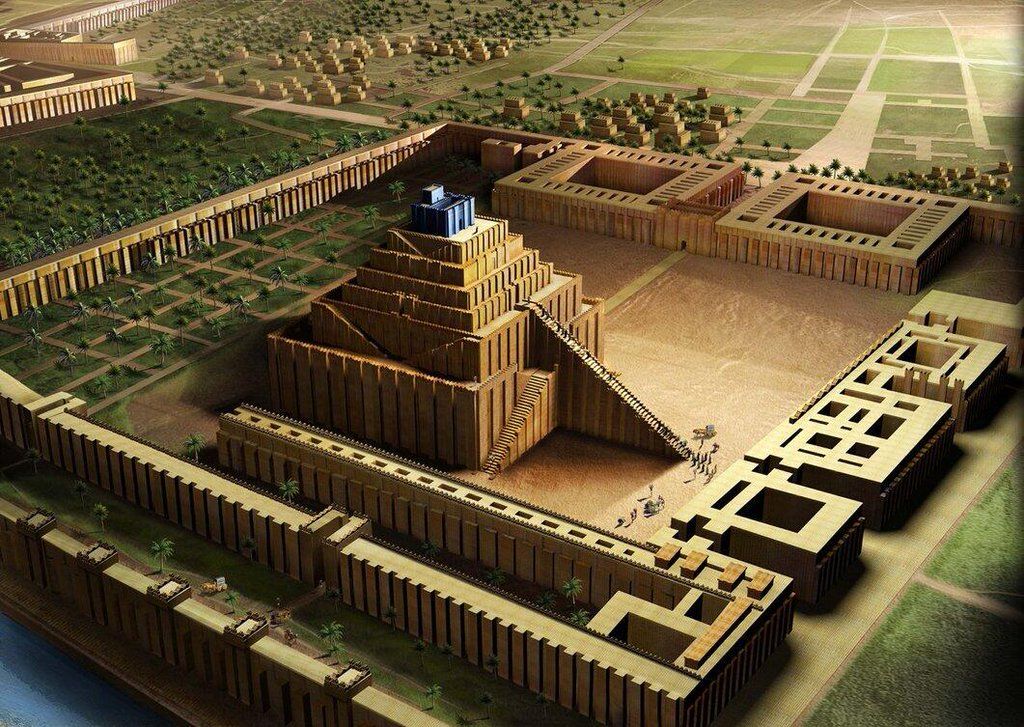
Etemenanki (Tower of Babel)
A seven-tiered ziggurat dedicated to Marduk, the Etemenanki was described in the Bible (Genesis 11:1–9) as a failed attempt to reach the heavens. Archaeological evidence suggests it stood 91 meters tall, with a temple at its summit. Its name ("Temple Platform of Heaven and Earth") reflected Babylon’s cosmological worldview.
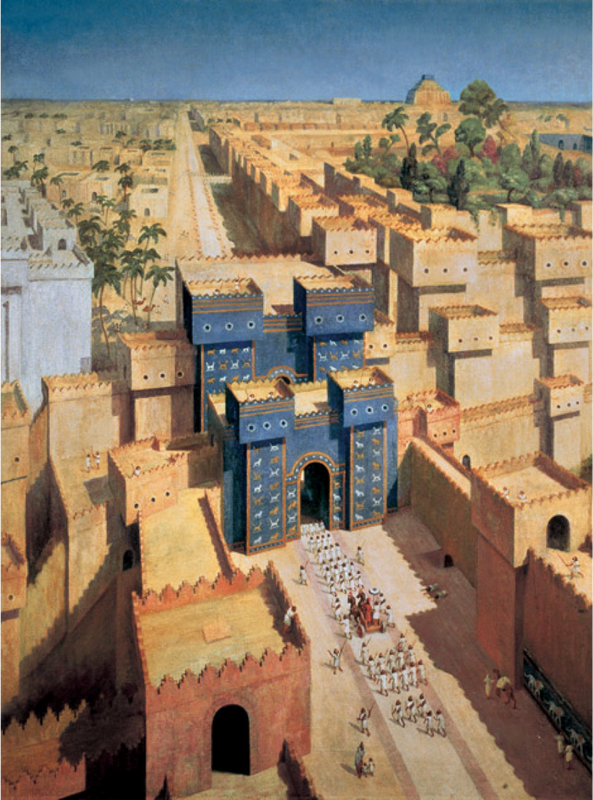
Ishtar Gate
Built by Nebuchadnezzar II (c. 575 BCE), this gate was the eighth entrance to the city and a masterpiece of glazed brickwork. Decorated with bulls and dragons (symbols of Adad and Tiamat), it marked the Processional Way leading to the ziggurat. The gate’s vibrant colors and intricate designs influenced later Persian and Hellenistic architecture.
Babylonian Walls
Nebuchadnezzar II’s double-walled fortifications, reinforced with glazed brick buttresses, stretched 18 km and included 100 watchtowers. The outer wall was 8 meters thick, while the inner wall reached 25 meters in height. These defenses repelled Assyrian and Median assaults, though they ultimately fell to Cyrus the Great (539 BCE).
Hanging Gardens
Though their existence is debated, ancient sources (e.g., Berossus, Diodorus Siculus) describe terraced gardens with screw pumps to irrigate exotic plants. If real, they were likely built for Nebuchadnezzar’s homesick wife, Amyitis, and symbolized Babylon’s engineering prowess.
Timeline of Babylon’s Rise, Peak, and Decline
Babylon’s history can be divided into five phases, each marked by distinct political and cultural developments:
Period
Key Events
Impact on Mesopotamia
Early Babylon (c. 2000–1894 BCE)
Babylon emerges as a minor city under Sumu-abum, replacing Kish as a regional power.
Competition with Larsa and Isin for dominance in southern Mesopotamia.
Establishment of Babylon as a political entity; shift from Sumerian to Akkadian cultural dominance.
Old Babylonian Empire (c. 1792–1595 BCE)
Hammurabi’s reign (1792–1750 BCE): Unification of Mesopotamia; promulgation of the Code of Hammurabi.
Military campaigns against Elam, Assyria, and Mari.
Economic prosperity through trade with Syria, Anatolia, and the Indus Valley.
Babylon becomes the cultural and legal center of Mesopotamia; Akkadian language standardizes administration.
Kassite Interlude (c. 1595–1155 BCE)
Symbolism and Mythological Interpretations of Babylon
Babylon’s legacy transcends its historical significance, embedding itself deeply into religious, literary, and esoteric traditions as a multifaceted symbol. Ancient texts portray Babylon as both a cradle of civilization and a cautionary emblem of hubris, corruption, and divine retribution. Its imagery—from the mythic Tower of Babel to the apocalyptic "great whore" of Revelation—reflects cultural anxieties about human ambition, moral decay, and the fragility of earthly empires. Later reinterpretations in art, literature, and media further cemented Babylon’s duality, oscillating between reverence for its architectural marvels (e.g., the Hanging Gardens) and condemnation of its perceived tyranny. This section explores Babylon’s symbolic representations in primary sources, its evolution in creative works, and its enduring esoteric associations, revealing how its myths continue to shape collective imagination.
Babylon in Ancient Religious Texts: Fear, Aspiration, and Moral Lessons
Babylon’s symbolic resonance in religious literature often serves as a moral or theological foil, embodying either human aspiration toward the divine or its catastrophic consequences. The Tower of Babel in Genesis (11:1–9) epitomizes the dangers of unchecked pride, where humanity’s collective ambition to "make a name" (Gen. 11:4) leads to linguistic fragmentation—a divine punishment that disperses humanity and curtails further centralized power. This narrative reflects Mesopotamian anxieties about centralized authority, particularly under the Neo-Babylonian Empire (626–539 BCE), which had conquered Jerusalem and exiled its elite. Conversely, Babylon’s portrayal as a city of wisdom in texts like Enuma Elish (the Babylonian creation epic) highlights its role as a cultural and intellectual hub, where gods bestowed knowledge upon humanity.
The Book of Revelation (17:1–18:24) presents Babylon as the whore of Babylon, a corrupt empire symbolizing idolatry, oppression, and moral depravity. This allegory draws from historical tensions between Judeo-Christian traditions and Babylonian rule, particularly under Nebuchadnezzar II, whose conquest of Judah (586 BCE) became a metaphor for divine judgment. The whore’s association with luxury ("the golden cup in her hand," Rev. 17:4) and her eventual fall ("Woe, woe to the great city," Rev. 18:10) underscores themes of imperial overreach and divine vengeance. Similar motifs appear in the Talmud (e.g., Bava Batra 74a–75a), where Babylon is depicted as both a site of exile and a center of rabbinic learning, illustrating its paradoxical role as both destroyer and preserver of Jewish culture.
"And the Lord said, ‘Behold, they are one people, and they have all one language; and this is only the beginning of what they will do; and nothing that they propose to do will now be impossible for them.’" — Genesis 11:6 (NASB)
—Divine response to humanity’s unified ambition, framing Babel as a warning against collective hubris.
"The great city that was clothed in fine linen, in purple and scarlet, and adorned with gold and precious stones and pearls, saying, ‘I sit as queen and I am no widow, and I will never see mourning.’" — Revelation 18:16 (ESV)
—The whore of Babylon’s arrogance, contrasting her perceived immortality with her inevitable destruction.
Reinterpretations of Babylonian Imagery in Art, Literature, and Media
Babylon’s architectural and mythological imagery has been repeatedly reimagined across centuries, often serving as a backdrop for themes of power, decay, or utopian aspiration. The Hanging Gardens of Babylon, though their existence is debated among historians, became a staple of romanticized depictions in the 19th and 20th centuries. Artists and writers used the gardens as a symbol of lost paradise or human ingenuity, such as in Gustave Doré’s illustrations (1865) for The Bible, where the gardens are portrayed as a lush, almost surreal escape from the arid Mesopotamian landscape. Similarly, Ferdinand von Richthofen’s 1885 description in China romanticized Babylon as a precursor to modern engineering, influencing later sci-fi visions of advanced ancient civilizations.
In literature, Babylon appears as a setting of both grandeur and doom:
John Milton’s Paradise Lost (1667) references Babel as a metaphor for Satan’s rebellion, linking it to the Fall of Man.
H.G. Wells’ The Time Machine (1895) contrasts the Eloi’s decadent but childlike civilization with the Morlocks’ subterranean industrialism, drawing parallels to Babylon’s opulence and hidden brutality.
Ursula K. Le Guin’s The Left Hand of Darkness (1969) uses Babylonian motifs to explore gender and power, with the planet Gethen’s dual-sexed society evoking the androgynous deities of Mesopotamian myth.
In film and television, Babylon’s legacy persists as a symbol of either utopian or dystopian futures:
Ridley Scott’s Exodus: Gods and Kings (2014) portrays Babylon as a sprawling, oppressive empire, emphasizing its architectural grandeur and religious syncretism.
The TV series Babylon 5 (1993–1998) reimagines Babylon as a futuristic space station, blending its historical connotations of diplomacy and conflict with sci-fi tropes.
Video games like Assassin’s Creed: Discovery (2023) feature Babylon as a hub of political intrigue and technological innovation, reflecting its real-world reputation as a crossroads of trade and culture.
"The Hanging Gardens were not merely a marvel of engineering but a testament to the human spirit’s ability to defy nature itself—a fragile paradise doomed to be forgotten."
—Themes in 19th-century travelogues and romantic poetry, e.g., Lord Byron’s Childe Harold’s Pilgrimage (1812–1818).
Babylon’s Duality: The "Golden City" of Wisdom and the Symbol of Corruption
Ancient sources present Babylon as a paradoxical entity, simultaneously a beacon of enlightenment and a den of vice. The Babylonian priest Berossus (3rd century BCE), in his Babyloniaca, described the city as the "mother of all arts and sciences," where the gods bestowed civilization upon humanity. This narrative aligns with Babylon’s historical role as a center of astronomy, mathematics, and law (e.g., the Code of Hammurabi). Yet, the same texts often depict Babylon’s rulers as tyrannical, with Nebuchadnezzar II’s madness (as recounted in Daniel 4) serving as a cautionary tale about divine punishment for arrogance.
The Talmud (Sanhedrin 107b) further illustrates this duality, portraying Babylon as both a site of exile and a refuge for Jewish scholars. The city’s destruction in 539 BCE by the Persians is framed as a divine judgment, yet its subsequent role as a hub for rabbinic academies (e.g., the Sura and Pumbedita schools) underscores its enduring intellectual legacy. This tension between Babylon as a city of light and a city of darkness is echoed in later esoteric traditions, where its symbols are co-opted to represent both spiritual awakening and moral decay.
"Babylon is the head of all kingdoms; from it the kingship went forth to the kings of the earth. The king of Babylon has made the whole earth like a boiling pot; he has shaken it without ceasing." — Jeremiah 51:7 (ESV)
—Babylon as an instrument of divine wrath, yet also as a metaphor for imperial dominance.
"The Chaldeans were the first to divide the circle into 360 degrees, and the Babylonians were the first to measure time with precision, giving us the 60-minute hour and the 24-hour day." — Berossus (as cited in Diodorus Siculus, Bibliotheca Historica, 1.19)
—Acknowledgment of Babylon’s scientific achievements, contrasting with its later demonization.
Astrological and Esoteric Associations of Babylon
Babylon’s influence extends into esoteric traditions, where its
Babylon in Language, Etymology, and Modern Usage
The name "Babylon" transcends its ancient Mesopotamian origins to embed itself in linguistic, cultural, and modern discourse. Its etymological journey across Semitic languages—from Akkadian Babilim (meaning "gate of God" or "confusion") to Hebrew Bavel (symbolizing exile)—reflects shifting religious, political, and symbolic associations. In contemporary usage, Babylonian linguistic legacies persist in idioms, legal terminology, and even popular culture, where its name is repurposed to evoke themes of power, decadence, or rebellion. This section examines the evolution of "Babylon" in English, French, and Arabic, traces its idiomatic and proverbial descendants, and explores its modern adaptations in branding, music, and political rhetoric.
The linguistic roots of "Babylon" reveal a complex interplay between geography, theology, and historical memory. The term’s migration through Semitic languages demonstrates how ancient empires shaped modern lexicons, while its adoption in European and Arabic traditions highlights cross-cultural exchanges. Below, the semantic shifts in key languages are analyzed, followed by an examination of Babylonian-derived phrases and their contemporary relevance. Additionally, a comparative table outlines Babylonian cultural contributions and their modern equivalents, illustrating the enduring influence of Mesopotamian thought on global civilization.
Linguistic Evolution of "Babylon" Across Semitic and Indo-European Languages
The term "Babylon" originates from the Akkadian Babilim (𒆍𒀭𒆠), a compound of bab-illatu ("gate of God" or "gate of the gods"), reflecting its significance as a religious and administrative center. By the Old Babylonian period (c. 1900–1600 BCE), the city was synonymous with imperial authority, a connotation later reinforced in Hebrew scripture. The Hebrew Bavel (בָּבֶל), derived from Akkadian via Aramaic, carries dual meanings: a literal reference to the city and a metaphor for exile or chaos, as seen in the Book of Jeremiah and Psalms.
In English, "Babylon" entered via Latin Babylonia (from Greek Babylōn), retaining its biblical and historical associations. The French Babylone similarly preserves the original phonetic structure, though its usage in literature (e.g., Voltaire’s Babylon as a critique of absolutism) expanded its symbolic range. Arabic Bābil (بابل) reflects the term’s persistence in Islamic scholarship, where Babylon was often contrasted with Jerusalem or Mecca in theological discourse. The table below summarizes key linguistic transformations:
Original Form
Language
Etymological Meaning
Modern Usage Notes
Babilim
Akkadian
"Gate of the gods" or "confusion" (Gen. 11:9)
Root of all subsequent Semitic forms; used in royal inscriptions.
Bavel
Hebrew
Exile, chaos (e.g., Bavel Babel in rabbinic literature)
Central to Jewish diaspora narratives; appears in Talmud as a symbol of divine punishment.
Babylonia
Latin (via Greek)
Geopolitical term for the empire
Used in medieval chronicles; influenced English "Babylonian" as an adjective.
Babylone
French
Literary and philosophical symbol (e.g., decadence, tyranny)
Adopted in Enlightenment critiques; e.g., Babylon as a metaphor in Candide.
Bābil
Arabic
Historical city and astrological reference (e.g., Bābil al-ʿUlā
Mentioned in Quran (e.g., Surah 50:13); linked to pre-Islamic astronomy.
The semantic drift from a geographic label to a metaphor for oppression or cultural decline underscores Babylon’s role as a topos—a recurring theme in literature and politics. For instance, the English "Babylonian captivity" (1305–1377 CE) refers to the Papacy’s relocation to Avignon, while French aller à Babylone ("to go to Babylon") implies indulgence or moral laxity, mirroring the city’s ancient reputation for luxury and corruption.
Idioms, Proverbs, and Phrases Derived from Babylonian Themes
Babylonian motifs have permeated global idiomatic language, often condensed into phrases that evoke its historical associations. These expressions frequently draw from biblical narratives, legal systems, or astronomical discoveries attributed to Mesopotamia. Below are categorized examples, illustrating their regional variations and modern applications:
Religious and Exilic Metaphors
The most enduring Babylonian idioms stem from the Hebrew Bible’s portrayal of exile and divine judgment. The phrase "Babylonian captivity" (from 2 Kings 24:14) originally described the deportation of Judean elites to Babylon (597–586 BCE) but now refers to any period of forced displacement or institutional control. In modern usage:
Political rhetoric: U.S. conservatives invoke "Babylon" to critique global governance (e.g., UN policies as "neo-Babylonian").
Pop culture: The band Babylon A.D. (1990s) adopted the name to evoke apocalyptic themes, while Babylon 5 (TV series) used it as a futuristic space station symbolizing human hubris.
Legal and Administrative Legacy
Hammurabi’s Code (c. 1754 BCE) introduced concepts like "lex talionis" ("eye for an eye") and standardized legal terminology. Modern derivatives include:
"Code": The term’s legal connotation persists in "code of conduct" or "legal code," though its Babylonian origins are rarely acknowledged.
"Writing on the wall": From Daniel 5:5–29, this phrase describes an omen of impending doom. Today, it signifies an inevitable crisis (e.g., financial markets: "The writing was on the wall for the company").
Astronomical and Scientific Terms
Babylonian astronomy gave rise to the zodiac, planetary names (e.g., Marduk → Mars), and timekeeping systems. Contemporary borrowings include:
"Zodiac": Directly from Babylonian zid ("path of the sun/moon").
"Planet": Derived from planētēs (Greek for "wanderer"), a term Babylonian astronomers used for celestial bodies.
"Eclipse": From Akkadian usurū ("to disappear"), documented in Mul.Apin tablets.
Regional Variations
Arabic: "Bābil al-ʿUlā" ("Upper Babylon") refers to the city’s ruins, while "min Bābil" ("from Babylon") implies ancient wisdom (e.g., "This proverb is from Babylon").
French: "Être à Babylone" ("to be in Babylon") means to live extravagantly, as in Molière’sLe Bourgeois Gentilhomme.
English: "Babylonian market" refers to chaotic or speculative trading (e.g., cryptocurrency bubbles).
Babylonian Cultural Contributions and Their Modern Equivalents
The following table highlights key Babylonian innovations and their contemporary counterparts, demonstrating how Mesopotamian thought underpins modern systems. The examples are categorized by domain, with historical context and modern applications:
Babylonian Concept/Invention
Modern Equivalent
Historical Context
Modern Application
Hammurabi’s Code
Legal codes (e.g., U.S. Constitution, UN Charter)
First major law code (1754 BCE); "eye for an eye" principle.
Archaeological Discoveries and Babylon’s Physical Legacy
The physical remnants of Babylon represent one of the most significant archaeological legacies of Mesopotamia, offering tangible evidence of its political, cultural, and intellectual achievements. Excavations spanning over a century have uncovered monumental structures, legal codes, administrative records, and artistic artifacts that collectively illuminate Babylonian civilization’s sophistication. These discoveries not only provide insights into urban planning, governance, and daily life but also raise complex ethical questions about the preservation, display, and repatriation of cultural heritage. The interplay between scientific reconstruction and historical interpretation continues to shape our understanding of Babylon’s enduring influence, while challenges such as fragmented records and misattributions necessitate interdisciplinary collaboration to clarify ambiguities.
Key archaeological findings serve as cornerstones for reconstructing Babylon’s historical narrative, from the iconic Code of Hammurabi stele to the vast archives of the Library of Ashurbanipal, many of which originated in Babylonian contexts. The physical legacy extends beyond texts to architectural marvels like Nebuchadnezzar’s inscriptions, which document the city’s grandeur during its Neo-Babylonian revival. These artifacts, however, are not merely relics; they are contested symbols, often entangled in debates over colonial-era excavations, museum ethics, and national sovereignty. Below, the focus shifts to the material evidence of Babylon’s past, its reconstruction in modern institutions, and the methodological challenges that persist in its study.
Major Archaeological Discoveries and Their Historical Contributions
The systematic excavation of Babylon began in the late 19th century, led by figures such as Robert Koldewey (1855–1925), whose work between 1899 and 1917 revealed the city’s urban layout, religious complexes, and administrative centers. Koldewey’s discoveries were pivotal in confirming Babylon’s status as a metropolis, though his methods—including the removal of artifacts to European museums—later became subjects of ethical scrutiny. Below are the most transformative findings and their scholarly implications:
"The past is never dead. It’s not even past."
— William Faulkner (adapted to reflect the living legacy of Babylonian archaeology)
The Code of Hammurabi Stele (c. 1754 BCE)
Discovery: Unearthed in Susa (modern Iran) in 1901 by Jacques de Morgan, though its origin is Babylonian. A fragmentary copy was later found in Larsa.
Contribution: The stele’s 282 laws, inscribed in Akkadian cuneiform, represent one of the earliest known legal codes, illustrating Babylonian concepts of justice, property, and social hierarchy. The prologue and epilogue emphasize Hammurabi’s divine mandate from Shamash, the sun god, reinforcing the intersection of law and theology.
Material: Diorite (symbolizing permanence), standing 2.25 meters tall, with reliefs depicting Hammurabi receiving the laws from Shamash.
Debate: The stele’s removal from Mesopotamia sparked early discussions on cultural heritage repatriation, though it remains in the Louvre Museum.
- The Library of Ashurbanipal’s Babylonian Tablets (7th century BCE)
Discovery: Found in Nineveh (modern Iraq) by Austin Henry Layard (1840s), but many tablets originated from Babylonian archives looted during Assyrian campaigns.
Contribution: Over 20,000 clay tablets in Akkadian and Sumerian, including epic literature (e.g., Epic of Gilgamesh), medical texts, astronomical observations, and Babylonian chronicles. These texts provide direct access to Babylonian intellectual traditions, even when composed under foreign rule.
Material: Sun-dried clay, inscribed with cuneiform using a reed stylus. Some tablets were baked for durability, while others were stored in mud-brick archives.
Significance: Demonstrates Babylon’s role as a cultural and scholarly center, even during periods of political subjugation.
- Nebuchadnezzar II’s Inscriptions (6th century BCE)
Discovery: Found at Babylon’s ruins, including the Ishtar Gate and Processional Way, during Koldewey’s excavations.
Contribution: Nebuchadnezzar’s prism inscriptions detail his restoration projects, such as the Etemenanki ziggurat (often identified with the biblical "Tower of Babel") and the Hanging Gardens (whose existence is debated). These texts blend propaganda with historical record, claiming divine favor for his reign.
Material: Enamel-covered bricks (for the Processional Way) and gypsum slabs (for inscriptions), inscribed in Akkadian.
Context: Highlights Babylon’s Neo-Babylonian revival as a deliberate cultural and religious reassertion after Assyrian dominance.
- The Babylonian Chronicles
Discovery: Multiple copies found in Nineveh and Babylon, including the Chronicle of Early Kings and the Chronicle of the Dynasty of Babylon.
Contribution: These historical annals record kingship lineages, military campaigns, and astronomical omens, offering a Babylonian perspective on events like the destruction of Jerusalem (586 BCE). They often attribute political shifts to divine will, reflecting Mesopotamian theocratic governance.
Material: Clay tablets, typically 10–20 cm long, written in cuneiform script.
Reconstruction Efforts and Ethical Debates in Babylonian Heritage
The physical reconstruction of Babylonian sites has been a contentious yet essential endeavor, blending archaeological rigor with museological ethics. Institutions like the Pergamon Museum (Berlin) and the Iraq Museum (Baghdad) have played central roles in preserving these artifacts, though their displays often reflect colonial-era priorities and nationalistic narratives. The ethical dilemmas surrounding repatriation, accessibility, and representation continue to evolve, particularly as source countries demand greater control over their cultural patrimony.
"The past is a foreign country; they do things differently there."
— L.P. Hartley (applicable to the challenges of reconstructing Babylon’s history through fragmented evidence)
The Ishtar Gate and Processional Way (Berlin’s Pergamon Museum)
Reconstruction: Assembled from ~120 glazed bricks (originally from Babylon’s 7th-century BCE gate) and 575 animal reliefs (lions, dragons), the gate was reconstructed in Berlin between 1926–1930 under Koldewey’s supervision.
Ethical Debates:
Ownership: Iraq has repeatedly requested the gate’s return, citing its status as a national treasure. Germany argues for its permanent display as a universal cultural heritage piece.
Contextual Display: Critics argue the gate is misleadingly presented as a "complete" structure, whereas in Babylon it was part of a larger ceremonial complex. The museum’s reconstructed street (Processional Way) further complicates interpretations by omitting original urban planning elements.
Digital Alternatives: Recent proposals suggest 3D reconstructions could offer non-destructive access while allowing physical artifacts to remain in Iraq.
- The Babylon Excavation Site (Modern Iraq)
Current State: The archaeological mound (Tell Amran ibn Ali) is partially excavated, with ruins visible near Hillah, ~85 km south of Baghdad. Key structures include:
Etemenanki Ziggurat: Only foundation layers remain; the upper tiers were likely wooden or mudbrick.
Temple of Marduk (Esagila): Identified through inscriptions and brick stamps, but most structures are below modern ground level.
Throne Room of Nebuchadnezzar: Unearthed by Koldewey, featuring gypsum reliefs depicting royal hunts and divine investiture.
Challenges:
Urban Encroachment: The site is surrounded by modern Babylon city, limiting excavation space.
Looting: Post-2003 conflicts led to the destruction of some tablets and removal of artifacts by looters.
Funding: Iraqi authorities lack resources for consistent preservation, relying on international collaborations (e.g., German Archaeological Institute).
- Repatriation Cases and International Law
Key Examples:
British Museum’s Babylonian Tablets: Over 70,000 cuneiform tablets from Babylon/Nineveh. Iraq has formally
Babylon’s enduring relevance lies in its ability to serve as both a historical case study and a cultural archetype, its layers of meaning continuing to inspire scholars, artists, and philosophers alike. As archaeological discoveries reshape our understanding of its physical legacy and linguistic traces persist in idioms and modern nomenclature, Babylon remains a bridge between antiquity and the present. Its story—one of triumph, decline, and mythic reinvention—challenges us to reconsider the interplay between power, faith, and human achievement. Ultimately, Babylon is more than a relic of the past; it is a dynamic force whose interpretations evolve alongside our own aspirations and fears, ensuring its place as a cornerstone of global heritage.
FAQ
What does the name "Babylon" mean in ancient Mesopotamian culture?
The name "Babylon" likely derives from the Akkadian word Bāb-ilim, meaning "Gate of the Gods." This reflects its role as a sacred city linking the mortal world to the divine in Mesopotamian religion, symbolizing both power and spiritual gateway.
How did Babylon’s meaning influence its political and religious power?
Babylon’s identity as the "Gate of the Gods" reinforced its authority by framing its kings (like Hammurabi) as divine intermediaries. Temples like the Esagila (home of Marduk) and grand ziggurats centralized religious and political control, making Babylon a cultural and administrative hub.
Were there different interpretations of "Babylon" in the Bible versus Mesopotamian texts?
In Mesopotamian texts, Babylon was a glorious, god-favored city, while the Hebrew Bible (e.g., Isaiah, Revelation) often portrays it as a symbol of oppression, idolatry, or divine judgment. This contrast stems from Babylon’s conquest of Judah and its role in exile narratives.
Did the concept of Babylon as a "gate" have any architectural or urban planning significance?
Yes—Babylon’s layout, including the Ishtar Gate and Processional Way, visually embodied its cosmic role. The gate’s blue glazed bricks (symbolizing the heavens) and lion/monster reliefs (guardians) mirrored the idea of a threshold between earth and the divine realm.
How does Babylon’s original meaning compare to modern uses of the word (e.g., "Babylon" in music or slang)?
Modern uses (like Bob Dylan’s Highway 61 Revisited or slang for chaos) often reference Babylon as a metaphor for systemic corruption or oppression, echoing its biblical associations. The ancient meaning—divine gateway—is rarely invoked, though some esoteric traditions still tie it to mystical or apocalyptic themes.

Leave a Comment
Comments are moderated before appearing. The data you submit is processed according to the Privacy Policy of Ns2.